

Inline (Online) Laser Coding Systems
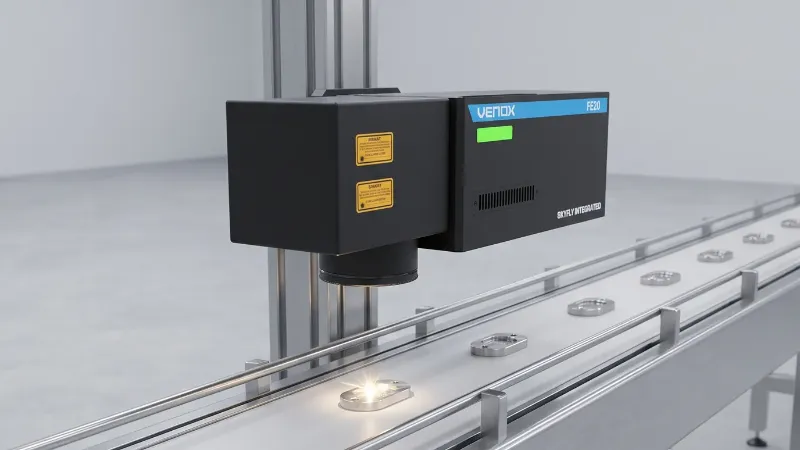
Inline laser coding systems are integrated solutions that mark products while they move along a conveyor or production line without stopping them. Variable information such as dates, batch numbers, serial numbers, DataMatrix codes, and QR codes is generated in real time for each product and marked onto the surface in synchronization with the line speed. This approach is used in continuous-flow production lines for packaging, automotive components, home appliance parts, cables, pipes, and profiles.
Unlike desktop and enclosed systems, inline coding requires the machine to be adapted to the production line rather than the part being brought to the machine. The marking head is mounted above or beside the line, and communication is established with the trigger sensor, encoder, and line control system. Therefore, system selection must consider mechanical integration and automation communication in addition to laser specifications.
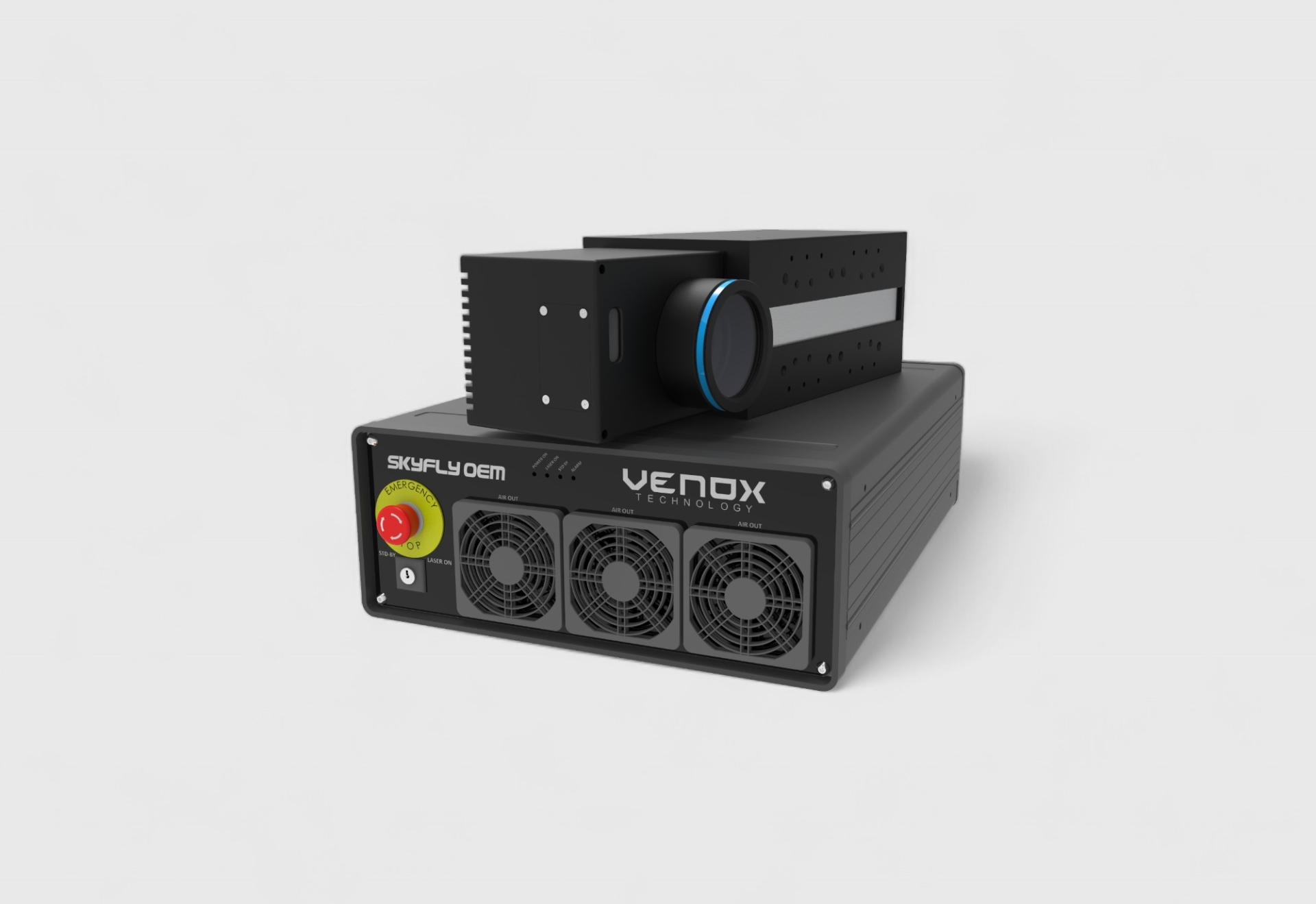
Venox offers solutions that can be directly integrated into production lines through OEM-compatible fiber, CO₂, and UV systems. You can request a technical consultation to determine the appropriate configuration based on your line speed, product type, and coding requirements.
How Does Inline Laser Coding Work?
On-the-Fly Marking
The fundamental feature of inline coding is marking products while they are in motion. The line speed is continuously measured by an encoder, and the galvo scanner directs the laser beam to compensate for product movement. This allows the code to be marked at the correct position without distortion as the product moves. Operating on the assumption of a constant speed without an encoder can cause codes to stretch or compress when line speed fluctuates.
Triggering and Positioning
A photoelectric or proximity sensor detects the arrival of each product and initiates the marking process. The distance and delay between the sensor and the marking point are defined in the software. If the spacing between products is irregular or product orientation varies, camera-based positioning can ensure that the code is marked at the same location on every product.
Variable Data Management
In inline coding, each product can carry different information. Automatic counters, date and time, shift codes, and batch numbers are generated by the software, while serial numbers can be retrieved from ERP, MES, or PLC systems. Preparing the data fast enough to keep up with the line speed and recording every marked code ensure an uninterrupted traceability chain.
Laser Source Selection
Fiber lasers are preferred for metal components; CO₂ lasers for cardboard, wood, glass, leather, and many types of plastic packaging; and UV lasers for sensitive plastics, cable insulation, and heat-sensitive materials. As line speed increases, codes must be marked within a few hundred milliseconds. Therefore, laser source power and scanner speed should be determined according to the target cycle time.
| Component | Function | Key Selection Consideration |
|---|---|---|
| Laser source | Generates a laser beam suitable for the material | Material type and line speed |
| Galvo scanner | Marks the code onto the surface | Scanning speed and marking area |
| Encoder | Measures line speed | Mechanical connection to the conveyor |
| Trigger sensor | Detects product arrival | Product shape and spacing |
| Control unit | Manages data and production line communication | PLC / ERP / MES protocols |
| Extraction unit | Removes fumes and particles | Material type and enclosure configuration |
Inline Laser Coding System Selection and Integration
Mechanical Integration
Mounting the marking head on a production line requires a vibration-resistant support structure, an adjustment mechanism that maintains the focal distance, and the ability to reposition the head when product height changes. When different product groups are processed on the same line, a motorized Z-axis or automatic focusing eliminates adjustment time during product changeovers.
Automation Communication
The system communicates with the production line PLC through digital inputs and outputs or industrial communication protocols. Ready signals, marking completion notifications, error status information, and job change commands are exchanged between the systems. Scenarios such as switching the laser to standby mode when the line stops or rejecting a product in the event of an error should be defined before commissioning.
Laser Safety on Production Lines
In inline systems, the enclosure generally does not cover the entire production line. Therefore, the marking area is surrounded by a local protective enclosure, light curtain, or interlocked guard. The protective design must prevent operator access while allowing uninterrupted product flow. The system's laser safety classification is evaluated and documented together with these protective measures.
Verification and Quality Control
The readability of marked codes can be verified using a camera or code reader installed on the production line. Automatic rejection of products with unreadable codes is standard practice in industries with traceability requirements. Transferring verification data to the recording system provides evidence for both customer audits and product return processes.
Pre-Commissioning Checklist
- Code quality and readability on actual products at the target line speed.
- Encoder connection and code integrity during line speed fluctuations.
- Trigger sensor position and compatibility with product spacing.
- Testing of PLC / ERP communication scenarios.
- Local protective enclosure and laser safety classification documentation.
- Extraction unit capacity and filter maintenance plan.
Determine the Right Coding System for Your Production Line with Venox
Achieving the right results from an inline laser coding investment requires evaluating laser specifications together with line speed, product geometry, and automation infrastructure. Sharing your line speed, product dimensions, coding requirements, and existing PLC/ERP configuration helps accelerate the technical evaluation.
You can explore Venox's laser marking systems and contact Venox to request an application assessment for your production line and obtain a quotation.
