
10 Critical Criteria When Buying a Laser Marking Machine
Making the right decision when buying a laser marking machine does not only mean choosing technical equipment. This decision directly affects production quality, product traceability, operational efficiency, maintenance burden, and long-term investment performance. For this reason, for many businesses, the laser marking machine purchasing process is not simply about the question “which device is more powerful?” What really matters is which system will better adapt to the current production need and future growth plan.
Today, laser marking machines are used in many different industries to permanently process content such as serial numbers, barcodes, QR codes, DataMatrix codes, lot information, technical data, safety markings, and logos onto product surfaces. These systems, used in fields such as automotive, medical, defense industry, metal processing, electronics, machinery manufacturing, and white goods, play a critical role in product identification and quality control. However, not every production line has the same needs. Therefore, if the right system is not selected, the business may face unnecessarily high costs, or the system purchased may not fully meet expectations in the actual production scenario.
The question “what should be considered when buying a laser marking machine” is therefore very important. Especially for companies making an investment for the first time, technical catalogs may often not be sufficient. This is because the actual decision is made when surface type, data structure, production speed, integration needs, service quality, and total cost of ownership are evaluated together. Below, we discuss in detail the 10 critical criteria that must be considered when buying a laser marking machine.
Technical Criteria to Consider When Selecting a Laser Marking Machine
Technical criteria are the fundamental factors that determine whether a system is truly suitable for your production needs. Here, it is not enough to look only at device specifications; what will be processed in production, which surface will be worked on, and the desired quality standard should also be taken into account.
1. Type of material to be marked
The first and most critical question is this: Which material will be marked? Metal, stainless steel, aluminum, plastic, coated surfaces, or technical components show different marking behaviors. Therefore, the laser marking machine to be purchased must be suitable for your actual material structure. Incorrect material compatibility may cause problems such as low contrast, insufficient readability, or loss of quality.
2. Type of data to be processed
Will only a fixed logo be processed on the product, or will serial numbers, barcodes, QR codes, DataMatrix codes, and variable production data also be used? This question is very important. This is because as the need for variable data processing increases, the system’s software, integration, and precision requirements also increase. Therefore, when evaluating laser marking systems, the data structure must be planned in advance.
3. Expected marking quality
Quality expectations are not the same in every application. For some companies, a readable marking alone may be sufficient, while in some industries, aesthetic appearance, high contrast, and camera-verifiable quality are required. When selecting a laser marking machine, this quality expectation must be clearly defined. Otherwise, even if the system technically works, it may remain insufficient in terms of product standard.
4. Production speed and cycle time
For businesses engaged in mass production, the marking solution must not slow down the production line. Therefore, the machine’s cycle time, data processing speed, and compatibility with the production rhythm should be carefully evaluated. A system operating at low speed can negatively affect the performance of the entire line. In this respect, laser marking machines should be selected by taking the actual production pace into account.
5. Marking area and part size
Not every product is the same size. Small electronic components and large metal parts do not have the same field requirements. Therefore, the marking area, focus structure, and part placement compatibility of the system to be selected are important. Especially if products of different sizes will be processed, more flexible solutions should be evaluated.
6. Integration capability
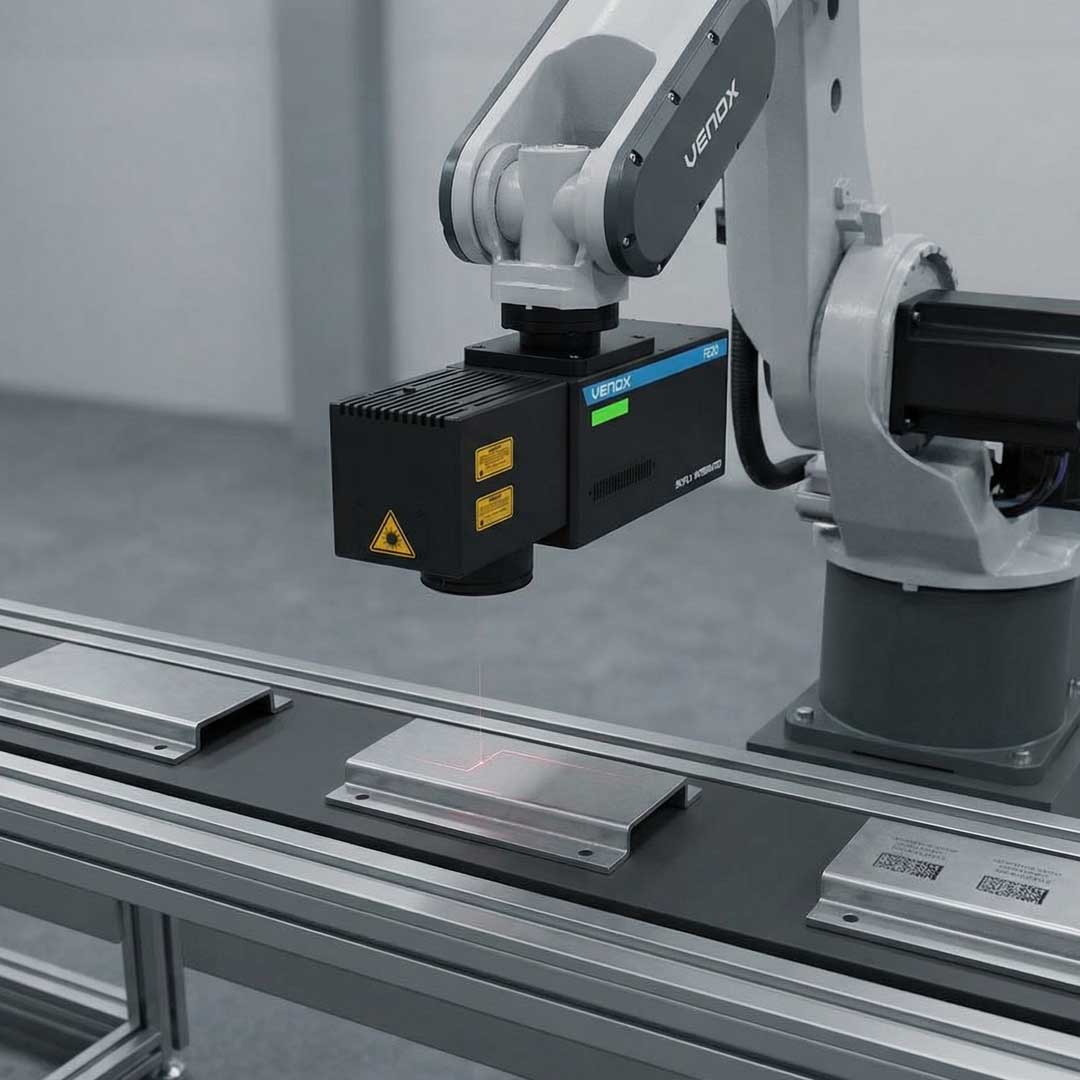
Will the machine be used independently, or will it be integrated into the production line? The answer to this question directly affects system selection. If a solution that will work together with a conveyor, sensor, PLC, camera verification system, ERP, or production tracking infrastructure is being sought, integration capability becomes critical. Therefore, not only laser performance but also system architecture should be considered.
To review technically suitable products, you can visit the laser marking machines page, or take a look at the laser marking systems page for different application structures.
Commercial and Operational Criteria That Should Not Be Overlooked in the Purchasing Process
Even if a laser marking machine is technically suitable, it may not be the right choice commercially and operationally. Therefore, criteria such as long-term usage cost, service support, and application experience must also be evaluated during the purchasing process.
7. Total cost of ownership
Looking only at the initial purchase price is often misleading. Installation, training, integration, maintenance, possible downtime cost, and service access are also part of the decision. When buying a laser marking machine, the total cost of ownership should be considered. A solution that appears low-cost in the short term may create a higher burden in the long term.
8. Service and technical support strength
In industrial production, how quickly support can be received in the event of a failure is as important as the system failing itself. Therefore, the supplier company’s service network, response time, spare parts access, and technical knowledge level must definitely be questioned. A strong service infrastructure increases the real value of the system purchased.
9. Sample application and testing opportunity
Having tests performed on the actual product before making a purchasing decision provides a great advantage. Through sample application, contrast, readability, speed, aesthetic quality, and data verification performance can be observed directly. This method is very valuable for comparing catalog information with real results in the field. Especially for companies making their first investment, this stage should not be neglected.
10. Compatibility with future production needs
The product structure needed today may not be the same as the products to be processed tomorrow. New product groups, different materials, or more intensive data processing needs may come into play. Therefore, when selecting a laser marking machine, it is necessary to consider not only today but also future production scenarios. Flexible and scalable systems become a more accurate investment in the long term.
Why is it important to work with the right supplier?
Buying a machine and implementing the right marking solution are not the same thing. The right supplier does not only offer a product; it also provides application knowledge, field experience, integration approach, and technical guidance. For this reason, when making a decision, attention should be paid not only to the machine itself but also to the competence of the solution partner.
What is the most common mistake in the decision-making process?
The most common mistake is reducing the entire evaluation to a single parameter. Some companies focus only on price, some only on wattage, and some only on the technical brochure of the device. However, the right choice should be made by considering material, data type, speed, quality, integration, service, and future plans together. Only in this way can a sustainable and efficient investment decision be made.
Why is this topic strong for SEO and AI visibility?
Topics such as “10 critical criteria when buying a laser marking machine” carry high value for both users in the research stage and companies with purchasing intent. Therefore, they are among strong content topics in terms of search engines and AI-based answer systems. This is because the user is directly looking for decision support here.
When buying a laser marking machine, in order to make the right decision, it is necessary to look not only at device specifications, but also at material compatibility, data structure, production speed, integration, service support, total cost, and future needs. When these criteria are evaluated together, a safer investment can be made from both a technical and commercial perspective. If you want to evaluate the most suitable solution for your business, you can review fiber laser marking solutions or receive expert opinion directly through the contact page.
