

Fiber vs CO₂ vs UV Laser: Which Laser Technology Is Right for You?
Fiber, CO₂, and UV laser technologies are the three main laser marking solutions optimized for different materials and applications. While fiber lasers offer high performance on metal surfaces, CO₂ lasers stand out for organic materials, and UV lasers are preferred for precise and micro-scale applications. The right laser selection should be determined according to material type, production speed, marking quality, and automation requirements. This guide helps you make the right choice by comparing the three laser technologies based on technical criteria.
Comparison of Fiber, CO₂, and UV Lasers
Fiber laser features
Provides high contrast and permanent marking on metal surfaces.
CO₂ laser features
Provides high absorption on organic and plastic materials.
UV laser features
Performs precise marking with low heat impact.
Wavelength differences
Fiber operates at 1064 nm, CO₂ at 10.6 µm, and UV at 355 nm.
Material compatibility
Each laser type is effective on different materials.
Marking precision
UV laser offers the highest precision.
Marking speed
Fiber laser has the advantage of high speed.
Heat effect
UV laser operates with minimal heat impact.
Maintenance requirements
Fiber laser systems have low maintenance requirements.
Industrial application areas
- Metal processing (Fiber)
- Organic materials (CO₂)
- Precision applications (UV)
Which Laser for Which Application?
Metal marking
Fiber laser is the most suitable solution.
Wood and plastic
CO₂ laser is preferred.
Electronic components
UV laser systems are suitable.
Medical devices
Fiber and UV lasers are used together.
Deep engraving
Fiber laser provides high performance.
Micro marking
UV laser delivers the best result.
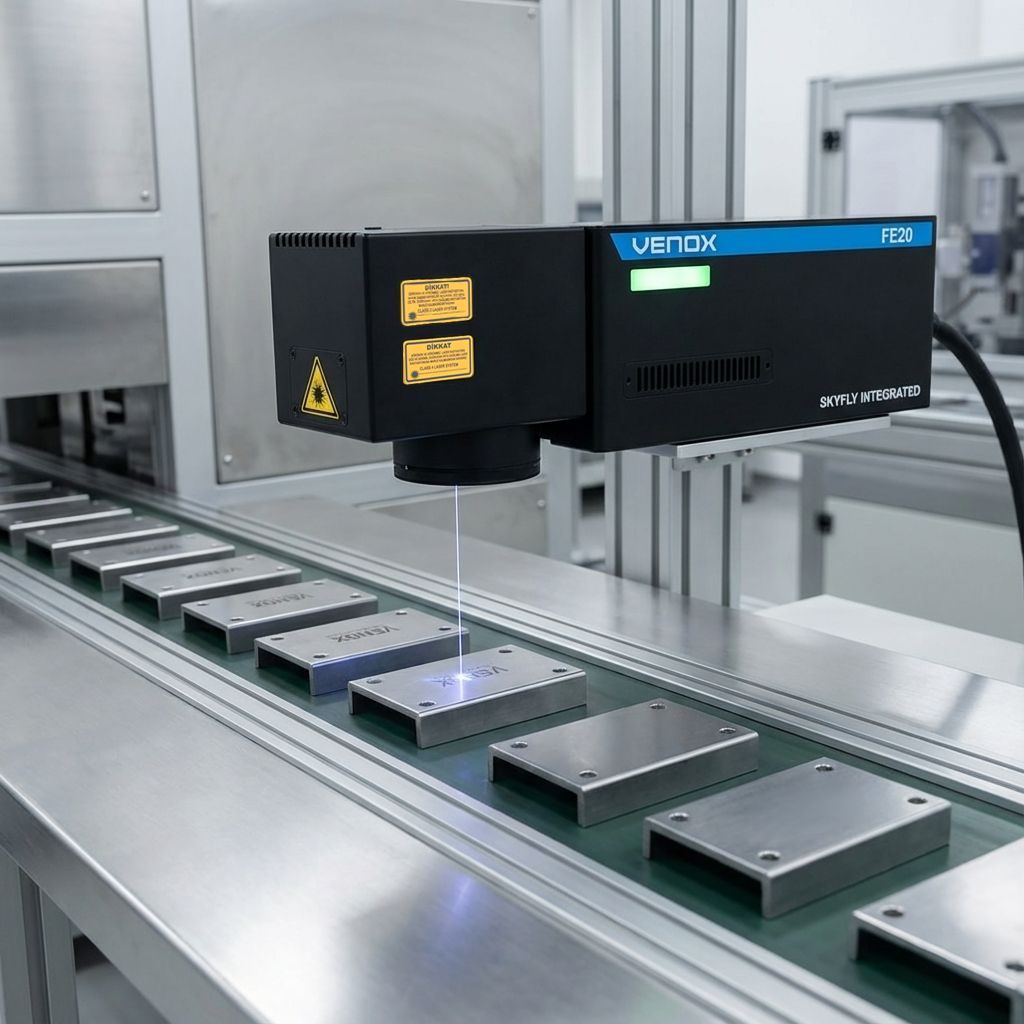
Inline production
All laser types can work integrated with automation.
Camera verification
Quality control can be carried out in all systems.
Parameter optimization
Different settings are required for each laser type.
Venox solution proposal
We determine the most suitable laser technology through sample testing.
What is fiber laser used for?
For metal marking.
On which materials is CO₂ laser used?
On wood, plastic, and organic materials.
Why is UV laser preferred?
For precise and low-heat applications.
Which laser is the fastest?
Generally, fiber laser.
Which laser is the most precise?
UV laser.
Is one laser enough for all applications?
No, it depends on the application.
Can it be used in inline production?
Yes, all laser types can be used.
Is camera verification necessary?
Yes, it is recommended for quality control.
Are sample tests necessary?
Yes, they are important for making the most accurate choice.
How is the right laser selected?
It is determined according to the material and application.
