

Laser Marking on Plastic: Material Types, Contrast, and Application Techniques
Plastic laser marking is a technology widely used in industrial manufacturing for identification, traceability, and product labeling. Different plastic types respond differently to the laser beam; therefore, the correct selection of laser type and parameters directly affects marking quality. Fiber laser, CO₂ laser, and UV laser systems can be used on plastic surfaces. This technical guide explains in detail laser marking methods on plastic materials, material compatibility, and examples of industrial applications.
Plastic Laser Marking Technology
Why is plastic marked with laser?
Plastic materials are widely used in industry because they are lightweight, durable, and have a wide range of applications. Laser marking provides permanent and clear marking on plastic surfaces.
Plastic types and laser compatibility
Different plastic types such as ABS, PP, PE, PC, and PVC respond differently to the laser beam.
Plastic marking with fiber laser
Fiber laser can create contrast on some plastic types, but it is not suitable for every plastic.
Plastic marking with CO₂ laser
CO₂ laser systems are widely used on plastics and organic materials.
Plastic marking with UV laser
UV laser systems provide high-quality marking on sensitive plastic surfaces.
Contrast formation
On plastic surfaces, contrast is formed as a result of the chemical or thermal interaction created by the laser with the material.
Surface deformation
Incorrect parameter use may cause deformation on the plastic surface.
Marking precision
UV laser systems are suitable for micro marking.
QR code and DataMatrix
2D code marking can be performed on plastic surfaces with laser.
Industrial application areas
- Electronic components
- Packaging products
- Medical plastic parts
- Industrial equipment
Plastic Marking Applications
Use in the electronics industry
High-precision marking is performed on plastic electronic components.
Medical device manufacturing
Permanent marking is required on medical plastic parts.
Packaging industry
Date and code marking is applied on plastic packaging.
Automotive parts
Identification marking is applied on plastic automotive components.
Inline production
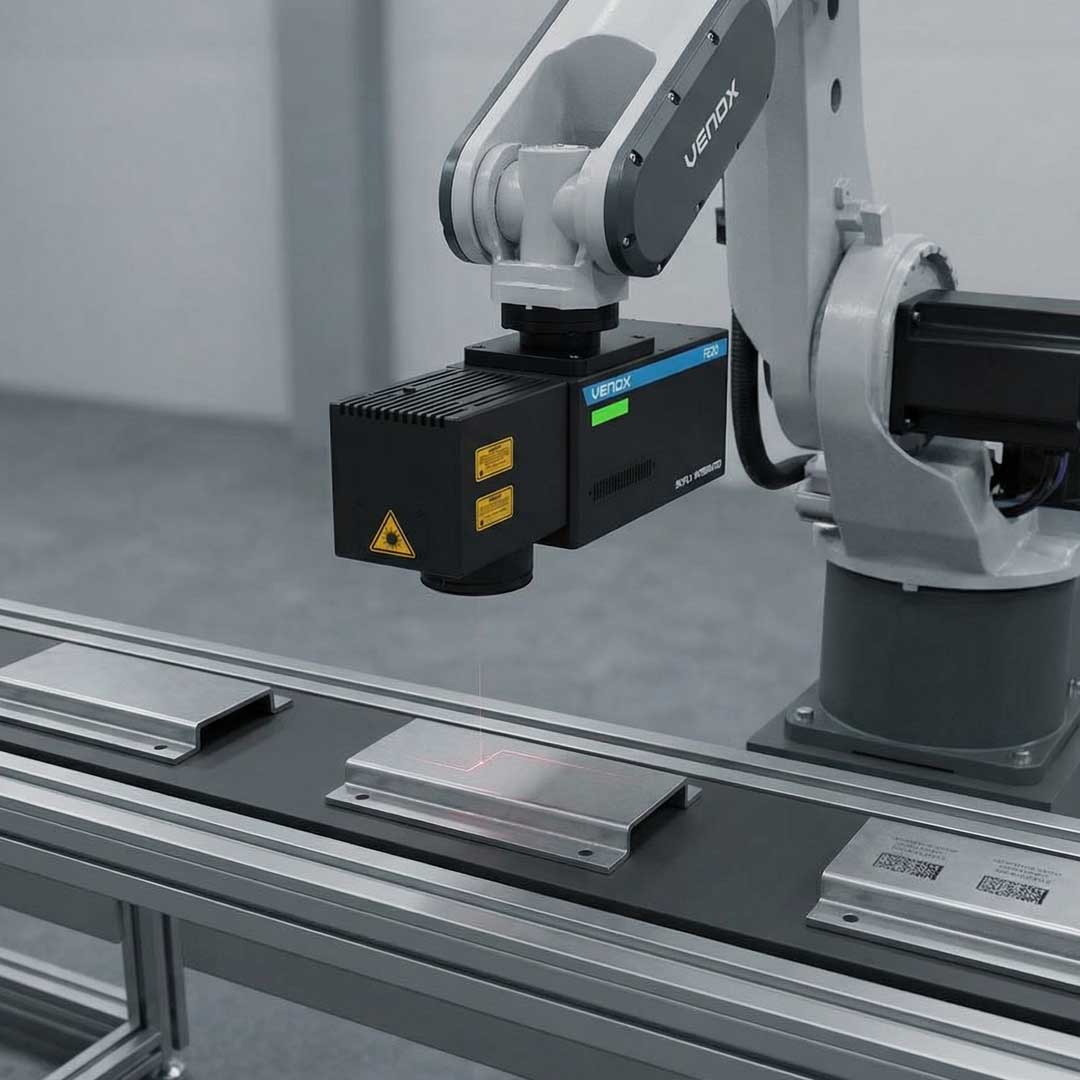
Laser marking systems can operate integrated into production lines.
Camera verification
The readability of codes is checked with camera systems.
Automation integration
Integration with PLC and MES systems can be provided.
Marking parameters
Laser power, speed, and frequency settings determine marking quality.
Sample testing process
Suitable parameters for each plastic type should be determined through testing.
Industrial advantages
Laser marking offers a fast, contactless, and permanent solution.
Can plastic be marked with laser?
Yes, it can be marked with the appropriate laser type.
Which laser is suitable for plastic?
CO₂ and UV laser systems are widely used.
Does fiber laser work on plastic?
It can be used on some plastic types.
Is the marking permanent?
Yes, laser marking is generally permanent.
Can a QR code be processed on plastic?
Yes, a QR code can be processed with laser.
Does deformation occur on the plastic surface?
It may occur with incorrect parameters.
Can it be used in inline production?
Yes, it works integrated with automation systems.
Can verification be done with a camera?
Yes, code inspection can be performed.
Is there a maintenance requirement?
Laser systems generally require low maintenance.
Are sample tests necessary?
Yes, they are recommended to determine the most accurate parameters.
