

QR Code Laser Marking Guide: Readability, Size, and Application Standards
QR code laser marking is a modern traceability method that enables products to be integrated with digital data. QR (Quick Response) codes are widely used in manufacturing, logistics, and retail sectors thanks to their high data capacity and fast readability advantages. With fiber, CO₂, and UV laser systems, QR codes can be marked on metal, plastic, glass, and organic surfaces. This guide explains in detail QR code marking techniques, readability criteria, and industrial applications.
QR Code Marking and Technical Features
What is a QR code?
A QR code is a barcode system that carries two-dimensional data.
Data capacity
Data such as text, URL, and serial number can be stored within a QR code.
Code size
The physical size of the code affects readability.
Module (pixel) structure
A QR code consists of square modules.
Error correction level
QR codes have an error correction algorithm.
Laser marking method
The QR code is created through surface contrast.
Contrast and readability
High contrast is critical for camera readability.
Marking precision
Small QR codes require high precision.
Effect of surface type
Metal, plastic, and glass produce different results.
Industrial application areas
- Product tracking
- Logistics processes
- Retail
- Digital integration
QR Code Marking Applications
Product traceability
QR codes provide digital tracking of products.
Metal surface applications
QR codes can be marked with fiber laser.
Plastic surface applications
Marking is performed with UV and CO₂ laser.
Packaging industry
QR codes are used on packaging.
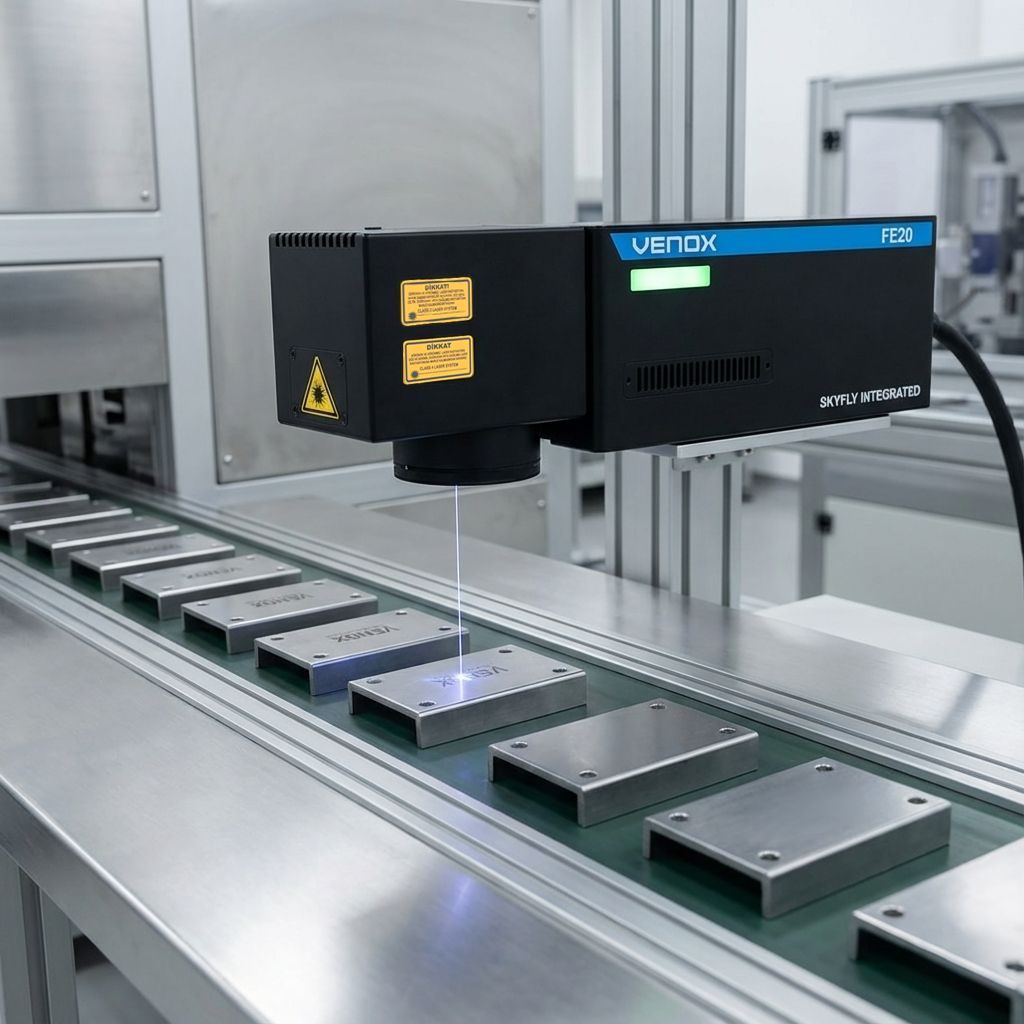
Inline production
QR codes are automatically marked on the production line.
Camera verification
Code readability is checked with camera systems.
Automation integration
Integration with PLC and MES systems is provided.
Parameter optimization
Settings must be adjusted for contrast and clarity.
Sample testing process
Code quality is optimized through testing.
Venox solution recommendation
We provide testing and analysis services for high readability.
What is a QR code?
It is a barcode system that carries 2D data.
Can a QR code be marked with laser?
Yes, it is possible with different laser types.
Can a QR code be made on a metal surface?
Yes, it is done with fiber laser.
Can a QR code be made on a plastic surface?
Yes, it is done with UV and CO₂ laser.
Is code size important?
Yes, it affects readability.
What is error correction?
It allows the code to be read even if it is damaged.
Is camera verification necessary?
Yes, it is necessary for quality control.
Can it be used in inline production?
Yes, it works integrated with automation.
Are sample tests necessary?
Yes, they are recommended for the best result.
How can I get a quote?
Send your sample, and let us analyze it.
