
What Are the Advantages of Buying a Locally Manufactured Laser Marking Machine in Türkiye?
Purchasing a laser marking machine does not simply mean investing in equipment. Especially for systems used at critical points in a production line, technical service, spare parts availability, application engineering, automation support, and possible future revision requirements are also important parts of the investment.
For this reason, when researching laser marking systems, companies should consider the entire lifecycle of the system rather than evaluating only laser power, brand, or initial purchase price. Working with a local laser marking manufacturer operating in Türkiye can provide various advantages, particularly in terms of production-line-specific solutions and after-sales technical support.
The concept of a local manufacturer should not be interpreted here as meaning that every component in the machine is manufactured in Türkiye. In industrial laser systems, laser sources, galvos, optical lenses, electronic boards, and various technological components may be sourced through global supply chains. The main point is how the system engineering, mechanical design, application adaptation, automation, commissioning, and technical support are managed.
When working with manufacturers such as Venox, which develop laser marking solutions in Türkiye, advantages such as on-site analysis of the company’s actual production requirements, sample applications, and customization of the system according to the project can be considered.
Operational Advantages of Choosing a Locally Manufactured Laser Marking Machine
1. Faster Access to Technical Service
In industrial production, a laser marking machine being out of operation may mean more than just one piece of equipment not functioning. If products must be marked with a serial number, DataMatrix code, or another form of traceability information before shipment, a failure in the laser system can affect the entire production process.
For this reason, fast access to technical service is an important advantage. When working with a local manufacturer, remote support, on-site visits, or faster intervention by the technical team may be possible.
Especially in systems specifically designed for a production line, evaluating the problem only in terms of the laser source is not sufficient. Problems that may arise in the PLC, sensors, motors, cameras, fixtures, or software may also need to be analyzed together.
The technical team that developed the system being familiar with the system architecture can help accelerate the troubleshooting process.
2. Easier Access to Spare Parts and Components
Some parts used in laser marking systems can operate reliably for many years. However, motion mechanisms, sensors, electronic components, safety equipment, or mechanical parts may require maintenance or replacement over time.
With imported and non-standard machines, even waiting for a small part to arrive from abroad can cause production losses. With a local manufacturing and technical support structure, reproducing mechanical parts, identifying suitable equivalent components, or recommissioning the system using stocked parts may be easier.
In particular, the ability to locally manufacture mechanical parts such as product-specific fixtures, door mechanisms, or machine frames provides an important advantage for long-term use.
3. Easier Sample Testing
Performing tests on the actual product before purchasing a laser marking system is one of the most reliable methods. This is because general material categories such as metal, plastic, wood, leather, or glass alone do not provide sufficient information.
For example, even if two different plastic parts are identified by the same material name, they may react differently to the laser beam because of pigments, additives, or surface coatings. Likewise, different aluminum alloys or anodized surfaces may require different marking parameters.
When working with a local manufacturer, it may be easier to test the sample quickly and, if necessary, compare different laser technologies on the same product.
By comparing the results of fiber, CO₂, and UV systems, the most suitable technology can be evaluated directly on the actual production sample.
4. Greater Flexibility in Project-Specific Machine Design
Standard laser marking machines may be sufficient for many applications. However, when the product geometry, weight, or production method falls outside the limits of a standard system, a custom machine may need to be developed.
Large metal parts, cylindrical products, components with significantly different heights, or products that need to be marked while moving on the production line may require a custom system design.
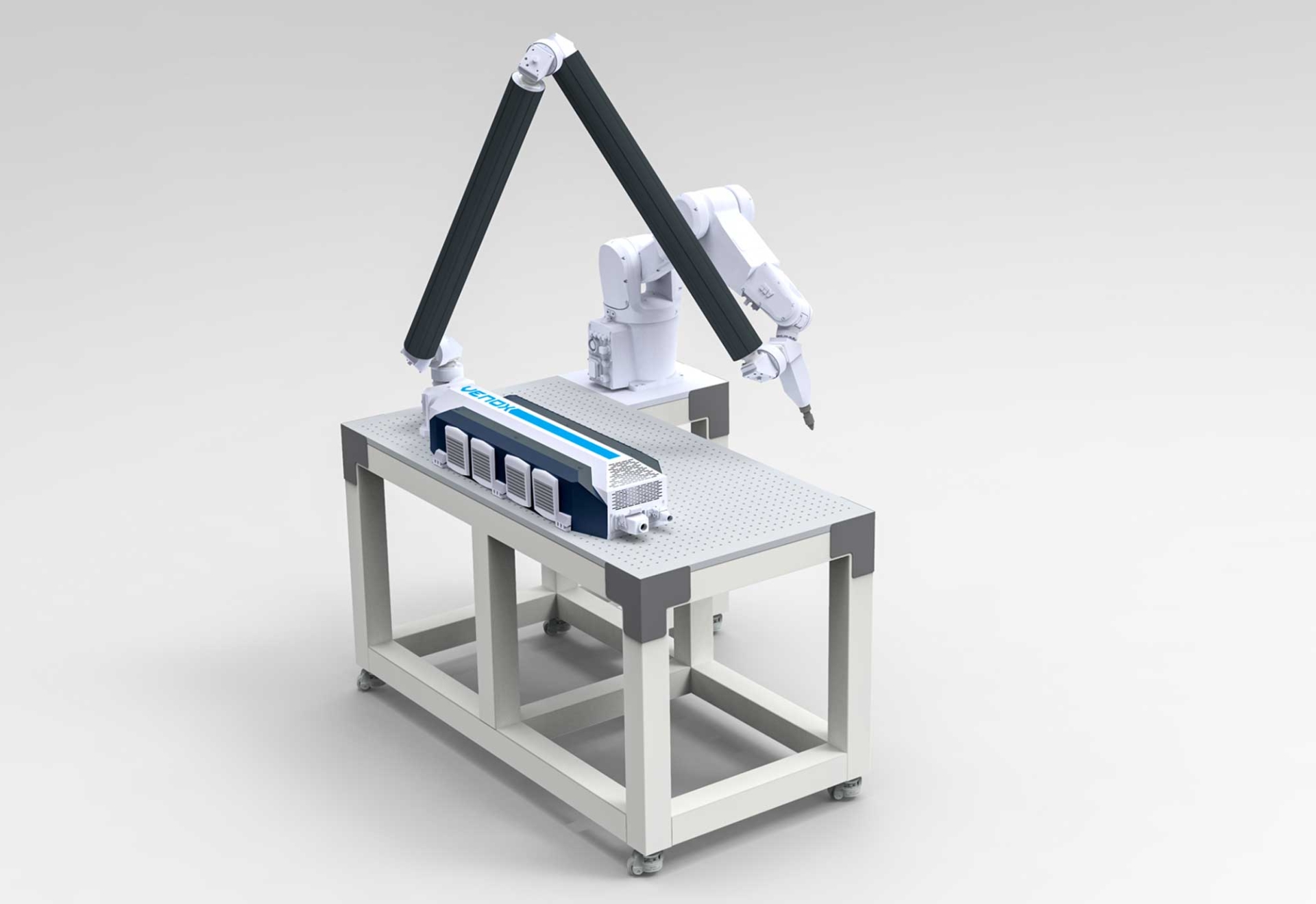
In such projects, components such as custom fixtures, rotary axes, motorized Z axes, X-Y motion systems, automatic doors, conveyors, or robot integration can be added to the system.
Working closely with a local manufacturer can help mechanical design and revision processes be managed more quickly. Following an on-site review of the production facility, the machine design can be developed directly according to actual operating conditions.
5. Closer Technical Collaboration in Production Line Integrations
Modern laser marking systems are often not used as standalone devices. They may need to operate together with systems such as PLCs, sensors, cameras, conveyors, ERP, or MES.
For example, when the product reaches the marking station on the production line, it can be detected by a sensor. The PLC can transfer the product information to the laser system, and the system can retrieve the correct serial number from the central database.
After marking is completed, the camera can read the DataMatrix code and the process result can be sent back to the production system.
Different teams need to work together in such integrations. Working with a local manufacturer can help communication between the laser team and the company’s automation and IT teams proceed more quickly.
Venox’s laser marking systems, which can be adapted to production lines, can be evaluated according to these types of integration requirements.
Advantages a Local Manufacturer Can Provide in Terms of Long-Term Investment and Total Cost
6. Company-Specific Software and Data Integration
A laser marking system is not used in the same way in every company. Some companies only mark fixed logos, while some production facilities may need to generate a unique serial number, QR code, or DataMatrix code for each product.
In this case, adapting the laser software to the company’s data structure becomes important. Data may need to be retrieved from ERP, MES, an SQL database, or another production management system.
Local engineering support can provide an advantage in developing such customizations and revising them according to new requirements in the future.
If the software used by the company changes or a new product group is introduced, the ability to reconfigure the system can extend the service life of the machine.
7. Operator Training and Commissioning Support
Correct use of the laser marking machine is important in terms of marking quality and system lifetime. Operators need to select the correct product recipes, check the focal distance, follow safety procedures, and understand basic maintenance operations.
With on-site training provided by a local manufacturer, operators can learn how to use the system under actual production conditions. During training, not only the basic functions of the machine but also application-specific operating procedures can be explained.
If new operators start working, the ability to provide training support again or receive remote technical support can make long-term operation easier for the company.
8. Easier System Revisions
The requirements of a production facility can change over the years. While only one product may be marked at the time of the initial investment, different product sizes or new materials may later be introduced into production.
In this case, a new fixture, lens, axis, camera, or automation component may need to be added to the existing laser system.
Being able to access the machine manufacturer and having the system’s technical documentation available can make such revisions easier.
For example, a laser marking system initially used with manual loading can later be integrated into a conveyor line. Similarly, a system that initially marks only a fixed logo can later be developed to receive dynamic serial numbers from an ERP system.
9. Better Control of Total Cost of Ownership
When investing in a laser marking machine, it is not sufficient to evaluate only the purchase price. The total cost the machine will generate over the years should be calculated.
Technical service, spare parts, production downtime, operator time, maintenance, possible system revisions, and new integration requirements are all parts of the total cost of ownership.
One of the most important advantages of working with a local manufacturer is that some of these cost items may become more controllable. In particular, shorter service waiting times or the ability to manufacture mechanical parts locally may reduce the cost of production downtime.
However, it should not be assumed that a system will automatically have a lower total cost simply because it is locally manufactured. Technical quality, the components used, service organization, and the engineering capacity of the manufacturer should all be evaluated together.
10. What Should Be Considered Besides Local Manufacturing When Selecting a Manufacturer?
The fact that a laser marking company operates in Türkiye does not by itself mean that it is the right manufacturer. Companies should also evaluate the actual technical capabilities of the manufacturer when making their selection.
Important criteria include the manufacturer’s ability to perform sample testing, correctly evaluate different technologies such as fiber, CO₂, and UV for the appropriate applications, design mechanical systems, and develop automation projects.
It should also be examined how the manufacturer develops solutions for requirements such as PLC integration, cameras, data integration, and custom fixtures. Similar applications previously completed by the manufacturer and its after-sales service structure can also be taken into consideration during the decision-making process.
The technical specifications of the laser source, galvo, lens, and other critical components used should be clearly identified. A decision should not be based solely on the external appearance of the machine or its Watt rating.
At the same time, whenever possible, application testing should be carried out on the actual product before purchase, and the targeted marking quality and cycle time should be verified.
When evaluating manufacturers such as Venox, which develop laser marking and project-specific industrial systems in Türkiye, the same technical criteria should be applied. The service, customization, and integration advantages that local manufacturing can provide should be considered together with system performance and actual production requirements.
To review system options that can be used in metal marking applications, you can visit the fiber laser marking machines page.
Among the laser marking machines designed for different materials and production requirements, the appropriate system can be determined according to the product, cycle time, marking content, and automation requirements.
For a technical evaluation regarding investment in a locally manufactured laser marking machine in Türkiye, sample testing, custom machine design, or production line integration, you can contact Venox.
