
What Is CO₂ Laser Marking? (Technical Guide for Organic and Plastic Materials)
CO₂ laser marking is a widely used laser technology for making permanent markings on organic and semi-organic materials such as wood, plastic, glass, leather, and textiles. CO₂ laser systems operating at a wavelength of 10.6 micrometers are highly absorbed by these materials and perform marking by creating controlled burning or vaporization on the surface. Thanks to the non-contact working principle, no mechanical deformation occurs on the surface. This guide explains in detail the working principle, advantages, and areas of use of CO₂ laser marking technology.
How Does CO₂ Laser Marking Technology Work?
What is CO₂ laser?
CO₂ laser is a system that generates a laser beam using a gas mixture (carbon dioxide, nitrogen, and helium).
Wavelength
CO₂ laser systems operate at a wavelength of approximately 10.6 µm.
Non-contact working principle
The laser beam performs marking without touching the surface.
Energy absorption
Organic materials absorb the CO₂ laser beam at a high rate.
Marking method
Marking is performed through burning, engraving, or vaporization on the surface.
Contrast formation
Dark or light color tones are formed with the burn effect.
Marking precision
CO₂ laser systems can perform detailed processing.
Speed performance
It can be used in high-speed production lines.
Consumable requirement
CO₂ laser systems generally do not require consumables.
Industrial application areas
- Wood products
- Plastic parts
- Glass surfaces
- Textiles and leather
Where Is CO₂ Laser Marking Used?
Wood and decorative products
Aesthetic marking is performed on wooden surfaces.
Plastic products
Date, logo, and code marking are performed on plastic surfaces.
Glass surfaces
Marking is performed on glass by creating a frosted effect.
Textiles and leather
It is used for pattern and logo processing.
Packaging industry
Date and lot codes are processed on packaging products.
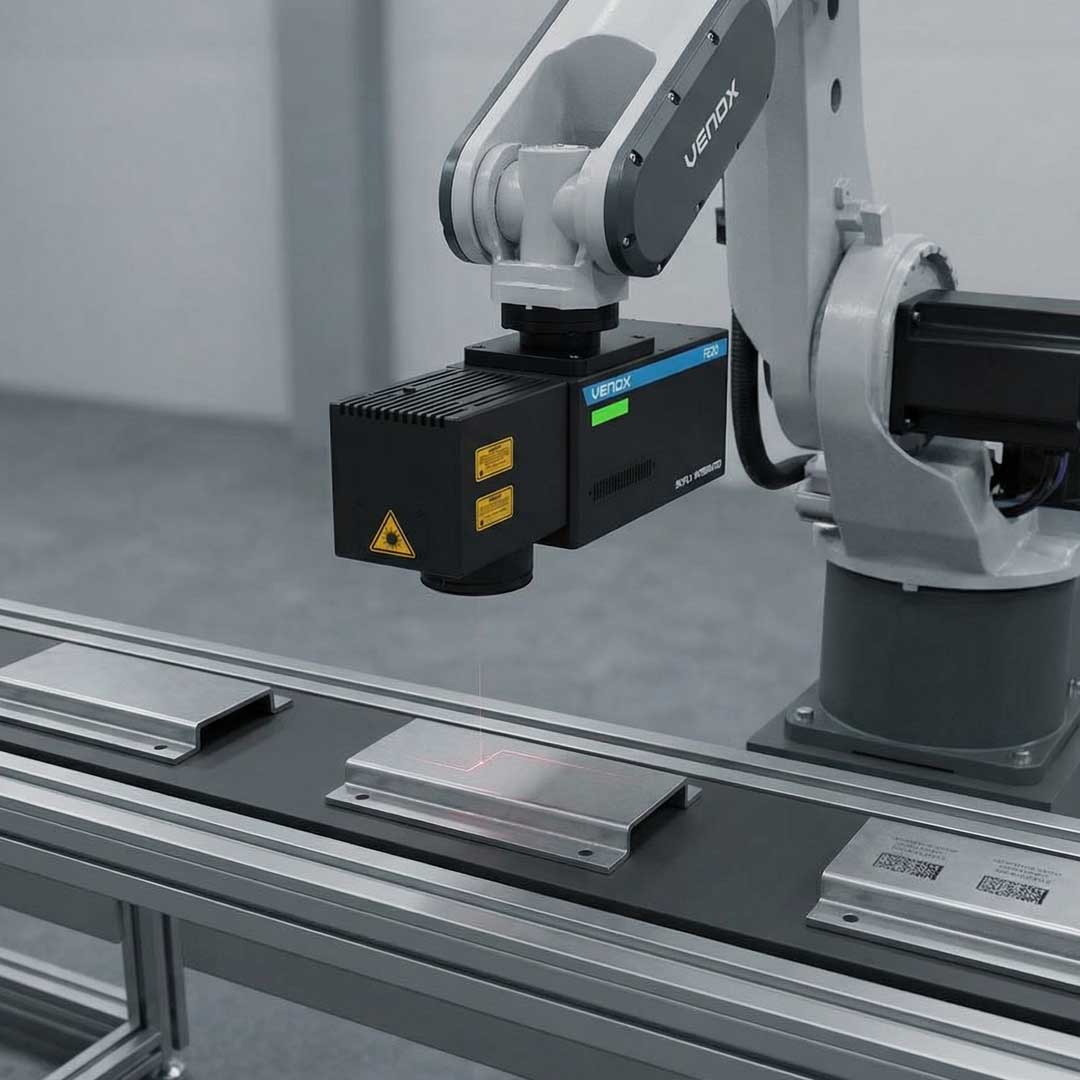
Inline production
CO₂ laser systems can operate integrated into production lines.
Camera verification
The readability of codes is checked with camera systems.
Automation integration
Integration with PLC and MES systems can be provided.
Parameter optimization
Power and speed settings must be adjusted correctly.
Venox solution recommendation
We provide the most suitable CO₂ laser solution through sample testing.
What is CO₂ laser marking?
It is a laser technology that performs marking on organic materials.
Which materials is it used on?
Wood, plastic, glass, and textiles.
Is the marking permanent?
Yes, it is generally permanent.
Can it be used on metal?
It is generally not used on metal.
Can it be used in inline production?
Yes, it works with automation.
Can QR codes be processed?
Yes, it is possible with laser.
Can camera verification be performed?
Yes, quality control can be performed.
Is there a maintenance requirement?
It requires low maintenance.
Can the burn effect be controlled?
Yes, it is controlled through parameter settings.
How can I get a quote?
Send your sample, and let us analyze it.
