
What Is Fiber Laser Marking?
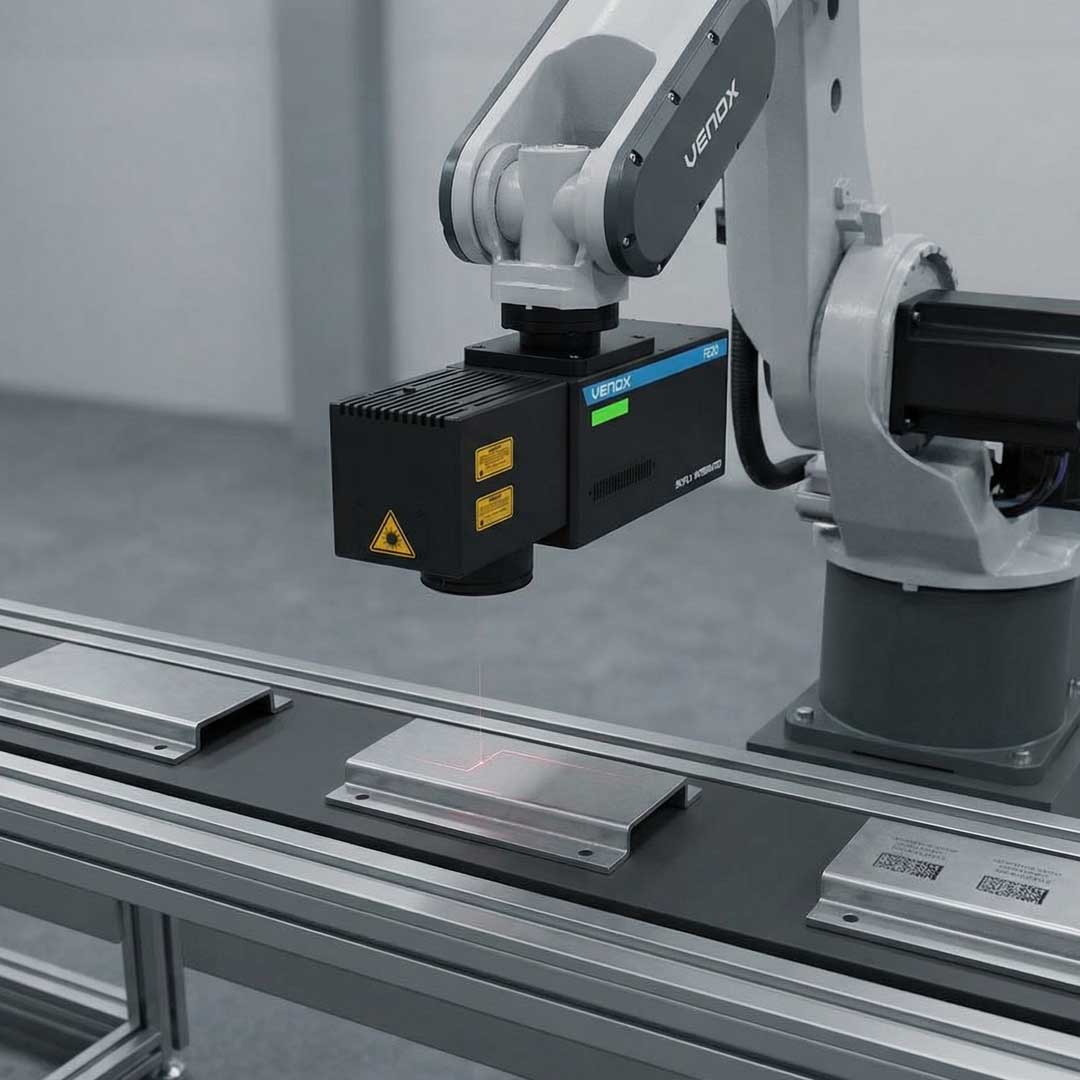
Fiber laser marking is an advanced industrial marking technology used to create permanent, clear and high-precision markings on product and part surfaces. In these systems, the laser beam is transmitted through a fiber optic infrastructure and applied to the surface in a controlled manner. As a result, content such as serial numbers, barcodes, QR codes, DataMatrix codes, logos, technical information, lot codes and similar data can be processed directly onto the product. Today, fiber laser marking systems are widely preferred especially in fields such as metal processing, automotive, defense industry, electronics, medical and machinery manufacturing.
For many businesses, marking no longer means only writing information on a product. Marking has a strategic role in terms of quality control, traceability, production tracking, after-sales support and brand standardization. Therefore, the marking technology used is expected to be both permanent and compatible with the production line. Fiber laser marking machines stand out among the solutions that meet these expectations. They are considered a strong option especially in applications that require precision, speed and low consumable needs.
Today, the question “what is fiber laser marking” is not only a technical curiosity, but also a frequently asked question by manufacturers who want to make the right investment decision. Because not every marking solution responds to the same need. The material to be processed, the type of data to be applied, the speed of the production line and the expected quality level are decisive in choosing the right technology. Fiber laser marking attracts attention especially because it offers high performance on certain material groups.
How Does Fiber Laser Marking Work?
The basic operating principle of fiber laser marking systems is based on directing a high-energy laser beam onto a specific surface in a controlled manner. During this process, effects such as color change, annealing, micro-abrasion or engraving-like marks can be created on the surface. The resulting marking creates a permanent information layer on the product. However, the main factor that increases the value of the system is its ability to perform this process with high precision and repeatable quality.
1. Transmitting the laser beam through a fiber optic structure
In fiber laser systems, the beam generated by the laser source is carried through the fiber optic infrastructure and directed to the processing point. This structure can offer more controlled and stable operation. In industrial applications, this stability is especially important for long-term use and high-repeat production.
2. Creating a controlled effect on the surface
A fiber laser marking machine applies the beam to the product surface with specific parameters. Power, speed, frequency and focus settings directly affect how the marking will appear on the surface. In this way, not only simple text but also serial numbers, technical data, 2D codes and precise logos can be created on the product.
3. Non-contact processing principle
Fiber laser marking systems operate without physical contact with the product surface. This feature provides a major advantage for sensitive parts and small components. Thanks to non-contact processing, the risk of deformation can be reduced and surface integrity can be better preserved. This becomes especially important in sensitive production areas such as electronics and medical parts.
4. High precision in small areas
In many industrial products, the marking area is limited. A very clear code, micro text or logo may need to be processed on a small surface. Fiber laser marking is preferred in such cases because it can offer high precision. This advantage is especially evident in the processing of small but critical data such as serial numbers and DataMatrix codes.
5. Ability to process variable data
Fiber laser marking machines can process not only fixed content but also variable data. Information such as production date, lot information, incremental serial number, batch code or QR code can be applied instantly. This feature is highly valuable in terms of production tracking and traceability.
6. Compatibility with automation systems
In modern production facilities, the marking system is expected not to operate independently, but to work integrated with the production line. Fiber laser marking solutions can be evaluated together with sensors, PLC infrastructures, conveyor systems and production tracking software. This contributes to making the production flow more organized and efficient.
To examine fiber-based solutions more closely, you can visit the fiber laser marking page, and to view other product groups, you can go to the laser marking machines page.
Why Is Fiber Laser Marking Preferred?
The main reason fiber laser marking systems have become widespread is not only that they can perform marking, but that they can do this efficiently, clearly and in a controlled manner in many production scenarios. The quality and speed advantage it offers especially on certain material groups makes this technology stand out.
7. Provides permanent marking
In many industrial applications, the information on the product must not be erased. Codes, technical data and logos processed with fiber laser marking can be made more permanent on the product. This feature provides a major advantage especially in traceability and quality assurance processes.
8. Can operate at high speed
For businesses engaged in serial production, insufficient marking speed is unacceptable. Fiber laser marking machines, when configured correctly, can adapt to high cycle speeds. This supports the overall performance of the production line and can reduce bottlenecks.
9. Can offer low consumable requirements
The reduction in the need for consumables such as ink, solvent or labels is an important advantage for many businesses. Fiber laser marking systems can offer a simpler operational structure in this respect. Especially in the long term, they can provide convenience for businesses in terms of maintenance and consumable management.
10. Can show strong performance in metal-focused applications
Fiber laser marking is widely preferred especially on metal and similar surfaces. When there is a need for clear marking on stainless steel, aluminum and various technical parts, this technology can be a strong solution. For this reason, it frequently stands out in industrial applications.
11. Suitable for barcode, QR and DataMatrix applications
Today, machine-readable codes are becoming increasingly important for production tracking and digital process management. Fiber laser marking can help apply these codes in a readable and consistent manner, even in small areas. This creates value in production, logistics and service processes.
12. Offers a professional product appearance
The clear appearance of the brand logo and technical markings on the product directly affects the perception of quality. Clean and consistent results obtained with fiber laser marking can contribute to a more professional appearance of the product. This is especially important for companies producing for corporate customers.
13. Supports precision production processes
It is not easy to perform controlled marking on small parts, narrow areas and surfaces that require high precision. A fiber laser marking machine can offer more controlled and clear application possibilities in such cases. Therefore, it is considered a strong option in industrial areas that require precision.
14. It is a strong content topic in terms of digital visibility
Topics such as “what is fiber laser marking” are valuable for both users conducting technical research and companies in the purchasing process. Therefore, they also create an important content area in terms of SEO and AI visibility. With clear definitions, application areas and the right internal link structure, such content can gain more organic visibility.
15. Contributes to long-term investment evaluation
When choosing a marking technology, it is necessary to consider not only today’s needs but also future production plans. Fiber laser marking systems can be a strong option in long-term investment evaluations due to factors such as speed, precision, permanence and operational simplicity. Therefore, for many manufacturers, it is an important alternative not only technically but also commercially.
Conclusion
Fiber laser marking is a powerful technology for businesses that need permanent, precise and production-line-compatible marking. It can offer significant advantages in terms of product identification, barcode and QR code processing, quality control, traceability and professional product appearance. If you want to evaluate the suitable solution for your business, you can examine fiber laser marking solutions in detail or get expert support directly through the contact page.
