

What Is UV Laser Marking Technology? Guide to Precise and Low-Heat Laser Marking
UV laser marking technology is an advanced laser processing method used especially for sensitive and heat-sensitive materials. UV lasers operating at a wavelength of approximately 355 nm are also referred to as “cold marking” technology because they can process materials with minimal heat effect. Electronic components, plastic parts, medical devices, and applications requiring micro-scale marking can be processed with high precision using UV laser systems.
Basic Operating Principle of UV Laser Technology
What is a UV laser?
A UV laser is a type of laser that operates in the ultraviolet spectrum. It generally has a wavelength of 355 nanometers and performs marking by creating a photochemical reaction on the material surface.
How does a UV laser work?
In UV laser systems, the laser beam is converted to a shorter wavelength by using special crystals. This short wavelength enables high-precision processing.
The importance of the 355 nm wavelength
Thanks to the short wavelength of UV lasers, very small focal points can be created. This makes micro-scale marking possible.
What is cold marking?
During UV laser processing, minimal heat is generated on the material surface. For this reason, the risk of deformation is reduced in sensitive materials.
UV laser marking process
When the UV laser beam is focused on the surface, a photochemical reaction occurs in the upper layer of the material. This reaction provides the marking contrast.
Types of UV laser marking
- Surface contrast marking
- Micro engraving
- Coating removal
- Plastic surface marking
Advantages of UV lasers
- Low heat effect
- High precision
- Micro marking
- High performance on plastic and sensitive materials
Micro marking with UV lasers
UV laser technology enables micro-scale marking. It is widely used in the electronics and medical industries.
Industrial application areas of UV lasers
It is preferred in electronics manufacturing, medical device manufacturing, sensitive plastic parts, and micro-component marking applications.
Why are UV lasers preferred?
Low heat effect and high precision have made UV laser technology important in precision manufacturing industries.
Application Areas of UV Laser Marking Systems
Plastic surface marking
UV lasers can provide high-contrast marking on plastic materials.
Electronic component marking
Micro marking on PCB boards and electronic components can be performed with UV lasers.
Medical device marking
High-precision marking is required in medical device manufacturing. UV lasers are widely used in these applications.
Glass and sensitive materials
UV lasers provide controlled processing on glass and some sensitive materials.
Micro serial number marking
Small-sized serial numbers can be processed with UV lasers.
Manufacturing requiring high precision
Precision marking is required in aerospace and electronics manufacturing.
Automation integration
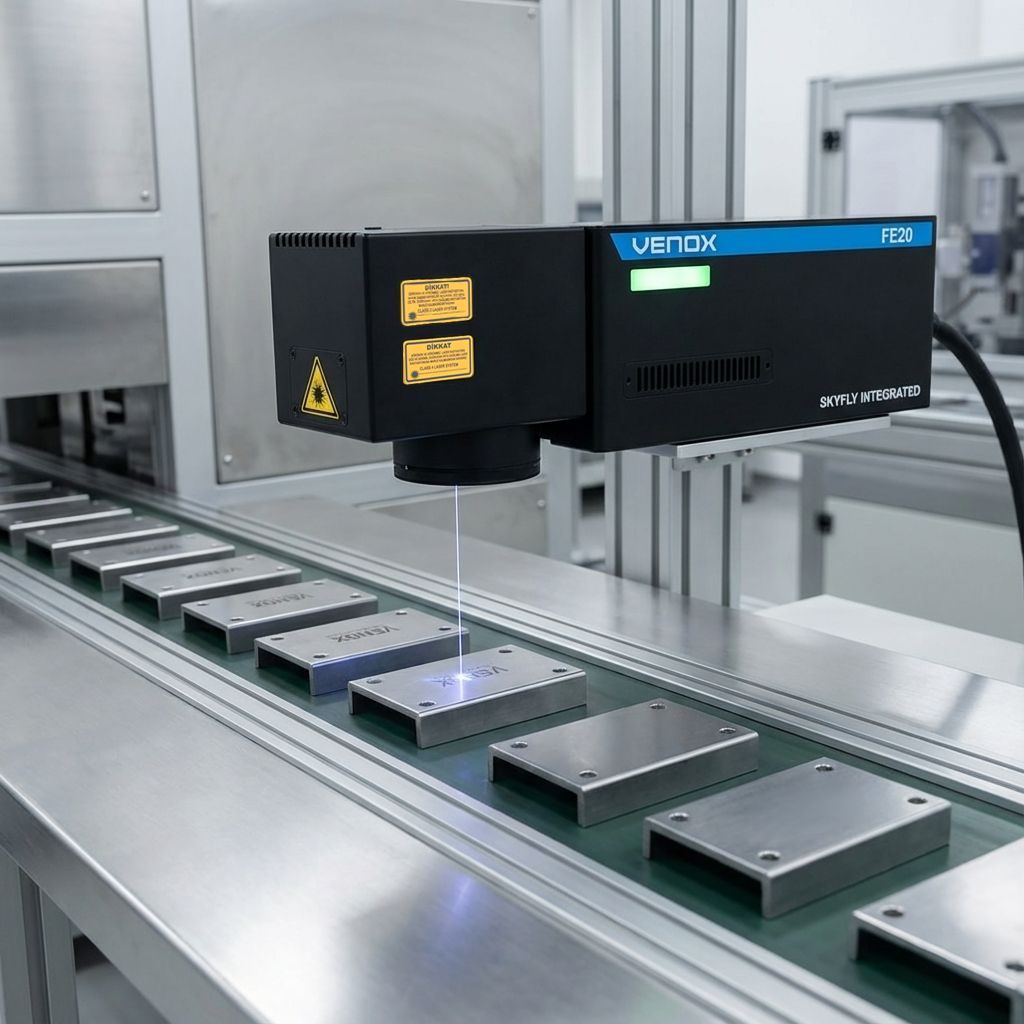
UV laser systems can work integrated with PLCs and production software.
Camera verification systems
Readability after marking can be checked with camera systems.
Laser safety
UV laser systems must comply with laser safety standards.
Choosing the right UV laser
Marking size, material type, and production speed are important in selecting the right system.
Does a UV laser work on metal?
Yes, but it is generally preferred for precision applications.
Is a UV laser suitable for plastic?
Yes, it is especially effective on sensitive plastics.
Can a UV laser perform micro marking?
Yes, it provides high precision.
Is a UV laser fast?
Yes, it can process small areas quickly.
Is a UV laser expensive?
It is generally more costly than other laser types.
Is it used in medical devices?
Yes, it is widely used.
Is it used in electronics manufacturing?
Yes, it is suitable for micro marking.
Can it be used in inline production?
Yes, it can be integrated with automation systems.
Is a UV laser safe?
It is safe with appropriate safety precautions.
Are sample tests necessary?
Yes, they are recommended for determining the correct parameters.
