
What Should Be Considered When Choosing a Laser Marking Machine?
Choosing a laser marking machine is not merely a decision to purchase equipment. This decision has a direct impact on production quality, traceability, speed, cost control, and long-term operational efficiency. For this reason, although many businesses initially focus only on price or the technical brochure of the device, the right choice actually requires a much more comprehensive evaluation. This is because the marking capacity, material structure, cycle time, and quality expectations required by each production line are different from one another.
Today, laser marking machines are widely used to process permanent information on metal, plastic, coated surfaces, electronic components, and technical parts. However, not every laser marking system is suitable for every application. An incorrectly selected system may cause problems such as low contrast, insufficient speed, integration issues, maintenance burden, or unnecessary investment cost. Therefore, businesses need to proceed by correctly analyzing their needs.
Especially for industrial organizations operating in automotive, medical, electronics, defense, machinery manufacturing, and mass production, the selection of a laser marking machine is a strategic investment. The right system does not only process information on the product; it also strengthens brand standards, facilitates quality inspection, and makes production data more transparent.
Technical Criteria in Laser Marking Machine Selection
When choosing a laser marking machine, technical requirements must first be clearly defined. This is because the success of the device is measured not only by whether it “works,” but by how well it adapts to the production process. At this stage, criteria such as material type, desired marking quality, production speed, and environmental conditions become decisive.
1. Type of material to be marked
The most fundamental factor in selecting the right system is the type of surface to be marked. Different materials such as stainless steel, aluminum, brass, plastic, anodized surfaces, coated parts, or electronic components exhibit different laser behaviors. For example, the laser marking system required by a company focused on metal production may not be the same as the expectations of a facility concentrated on plastic parts. Therefore, the material list should be clearly prepared before making a selection.
2. Nature of the marking content
Will the processed data be only a simple logo, or will serial numbers, barcodes, QR codes, DataMatrix codes, lot information, and variable production data also be used? This question is highly important. Because if the laser marking machine will only be used to process fixed content, the expectation will be different; if real-time production tracking will be carried out with variable data, the need will be different. Especially in sectors requiring traceability, the system’s variable data processing capacity becomes critical.
3. Marking speed and production cycle time
In mass production environments, a slow-running system can reduce the efficiency of the entire line. Therefore, when evaluating laser marking machines, the device’s processing capacity per second, repeatability precision, and line integration compatibility should be taken into consideration. A device to be used on lines where many products pass per minute will not be the same as a system selected for lower-volume custom production environments.
4. Desired contrast and visibility level
In some applications, it is sufficient for the marking to be permanent; in others, high contrast and readability from a distance are required. Especially in production environments where verification is performed with quality control cameras, the clarity of the marking is of great importance. When choosing a laser marking machine, the character size to be processed, line thickness, readability standard, and surface contrast should be considered.
5. Working area and part size
Small electronic components and large metal parts do not have the same area requirements. The marking field, focal distance, and part positioning structure are important in the selection process. If products of different sizes will be processed on the same system, laser marking systems that offer flexible use should be preferred.
6. Integration requirements
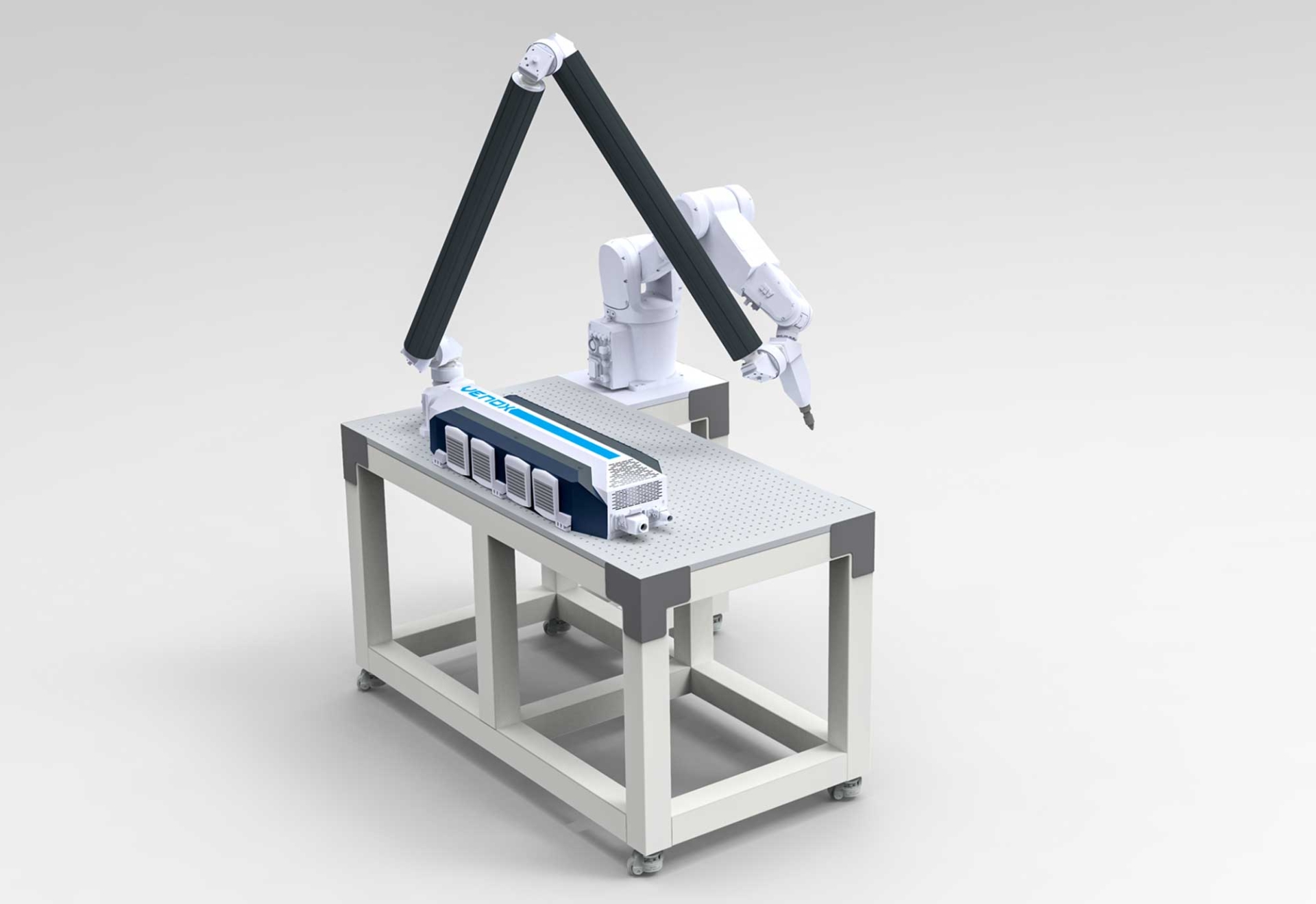
Will the machine operate independently, or will it be integrated into an existing production line? This question is often overlooked during the selection process. However, in projects that require compatibility with conveyors, robotic arms, sensors, PLC, ERP, or production tracking infrastructure, integration capability is vital. Therefore, not only the laser performance of the device but also its software and communication infrastructure should be evaluated.
7. Ease of use and software interface
No matter how powerful a laser marking machine is, if it cannot be used efficiently by the operator, it cannot fully demonstrate its potential. A user-friendly interface, recipe management, ease of data retrieval, fast format change, and error-preventive controls should be evaluated during the selection process. Especially in facilities operating with shift-based production, ease of use provides a significant advantage.
To examine more comprehensive product structures, you can be directed to the laser marking machine page, and to see different application options, you can visit the laser marking systems page.
Commercial and Operational Criteria in Laser Marking System Selection
Commercial and operational criteria are just as important as technical specifications in the selection process. Businesses often focus on the initial purchase price of the device. However, the right investment decision should be evaluated together with the total cost of ownership and long-term usage advantages. A system may appear economical at first glance; however, it may generate higher costs due to maintenance, service, downtime, and lack of integration.
8. Total cost of ownership
When purchasing a laser marking machine, considering only the device price can be misleading. Installation, training, maintenance, service access, spare parts support, software updates, and production line adaptations are also part of the cost. Especially for companies engaged in high-volume production, the total cost of ownership may become more important than the initial investment amount.
9. Quality of service and technical support
One of the most critical issues in industrial production is continuity. If fast intervention cannot be received when a system fails, the production line may be disrupted. Therefore, when evaluating laser marking machines, the supplier company’s technical service network, response time, remote support capability, and spare parts access must be questioned. Strong technical support is one of the factors that increases the real value of the machine.
10. Compatibility with future production plans
Current needs may be small-scale; however, production volume may grow over time. New product groups, new materials, or new coding standards may come into play. Therefore, the selected laser marking system should be compatible not only with the current usage scenario but also with future growth plans. Systems that offer a flexible structure become a more accurate investment in the long term.
11. Brand reliability and project experience
It is not enough for the supplier company to merely sell a product; it must also have application knowledge. This is because marking requirements differ in every production environment. A solution partner with sectoral experience can accelerate the selection of the right laser marking machine and reduce the risk of unnecessary investment. Therefore, references, application experience, and project approach should be carefully examined.
12. Sample testing and application verification
If possible, tests should be performed on real product samples before purchasing. Catalog data does not always fully reflect the result in the field. Thanks to sample tests, contrast, speed, readability, surface response, and aesthetic quality can be directly observed. This is especially important for businesses that will invest in a laser marking machine for the first time.
13. Occupational safety and suitability of the working environment
The production layout of the area where the machine will be installed, operator safety, and environmental conditions should be taken into consideration. Dusty environments, limited spaces, high temperatures, or moving production lines may affect the selection process. Therefore, laser marking systems should be evaluated not only in terms of performance but also according to the physical conditions of the factory where they will be installed.
14. Advantage in terms of content strategy and digital visibility
Technical and commercial content prepared about laser marking machines is an important tool not only to inform users but also to gain visibility in search engines. Well-structured content provides visibility for variations such as “laser marking machines,” “laser marking systems,” and “laser marking equipment.” In addition, AI-based answer systems can more easily interpret content that includes clear definitions and sectoral examples.
15. For which businesses is the right selection more critical?
System selection is much more critical for automotive suppliers, medical equipment manufacturers, electronic component manufacturers, machinery manufacturers, and high-volume metal processing companies. This is because in these businesses, marking is not merely a visual process; it is a direct part of the operation in terms of quality assurance, regulatory compliance, and product traceability. Therefore, choosing the right laser marking machine also creates a competitive advantage.
Conclusion
The factors to consider when choosing a laser marking machine can be summarized as material compatibility, marking content, production speed, integration level, software capability, service support, and long-term investment planning. Choosing the right system does not only mean achieving clearer marking; it also means more organized production, stronger quality control, and more sustainable operations. If you want to determine the most suitable solution for your business, you can examine fiber laser marking solutions for product details or request expert advice directly through the contact page.
